A few years ago I put together a list of ‘living books’ for South Africa. These are not textbooks: the point here is to learn to love the country, not to memorise factoids that might appear on an exam paper. I am working on more up-to-date, user friendly suggestions, but in the meantime these notes may be useful: Living Books for South Africa.
This story structure page is a simple but helpful tool for several stages of teaching narration. I am generally wary of ‘notebooking pages’, but make an exception for this, which only works because it is exceptionally simple. (You can find a download link after the explanation.)
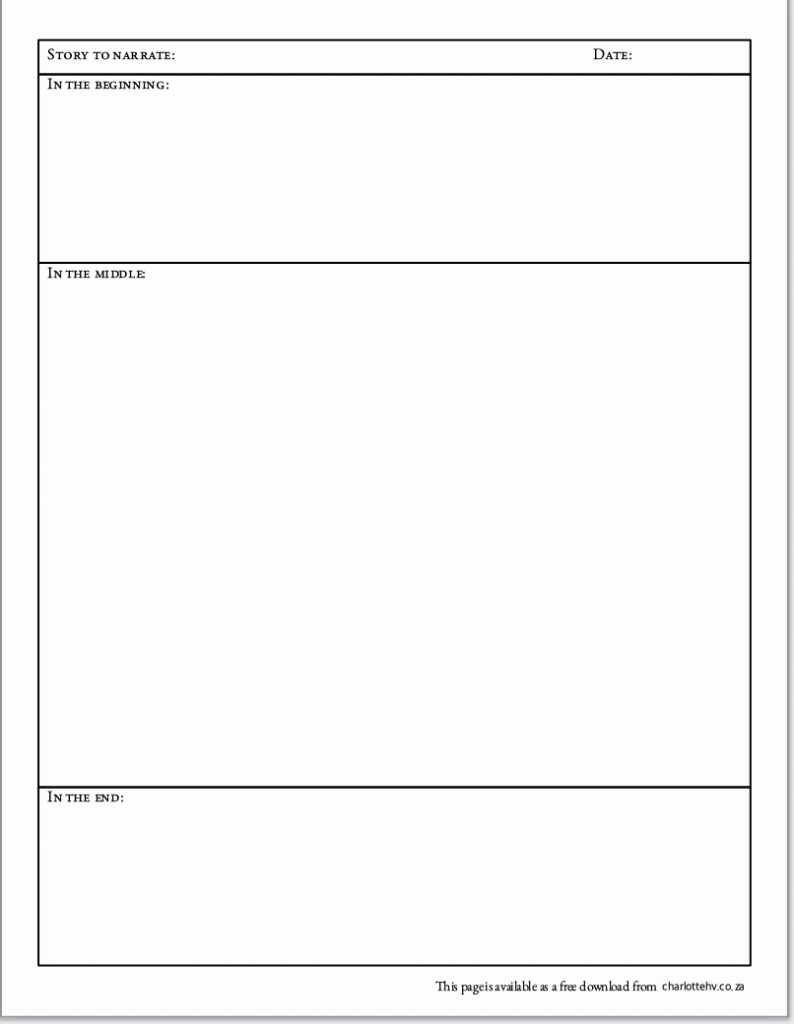
Children working on longer oral narrations can dictate to a parent/teacher, with the goal of including one ‘thing’ in each block, or perhaps a few things in the middle block. It’s also helpful when a child feels overwhelmed by the complexity of a passage. Sometimes, ‘How about instead of telling me about it, we fill in a story structure page,’ can turn a lesson around. It can also be a less intimidating way to start written narrations than having to face a blank page (although the blank page must be faced eventually).
Using this page to narrate assumes and reinforces the idea that the story has a beginning-middle-end structure, with rising and falling action. This is a very common structure, and one that it’s good for students to be familiar with, but it’s not appropriate for every narration. For example, in many nature lore books the story is mostly a container for information about the natural world, and it’s not terribly helpful to narrate focusing on form. This tends to work better for literature or history readings.
Download: Story Structure A4 size | Story Structure US letter size